Energy News

Twitter facebook 100% Wind Powered


This Site is Hosted With 100% Wind Energy


News Channels

News: Solar
Solar
News: Wind
Wind
News: Water
Water
News: Geothermal
Geothermal
Our goal at Energy Trace is to provide you with a central source of current information about energy efficiency products and practices. Here you will find access to the various news topics related to energy as well as the daily video, news releases, and a featured article.
We bring you refined news on renewable energy from around the world. Refer to the news channels on the left. Click on any news topic screen to display current news on that subject.
News: General
General
News: Fuel Cell
Fuel Cell
News: Biomass
Biomass
News: Enviroment
Environment


The Latest Articles and Videos


Daily Video (Apple iPad friendly)

This video link is to information created and maintained by other public and private organizations. These links provide additional information that may be useful or interesting and are being provided consistent with the intended purpose of the Energy Trace Web site. Energy Trace does not control or guarantee the accuracy, relevance, timeliness, or completeness of this outside information.


Feature Article

Geothermal Education 101

By Christine Ethier

Geothermal Technologies

Geothermal energy is the energy that comes from heat stored in the ground, whether from the potential energy trapped from the sun in shallow ground or the hot water and hot rock a few kilometers below the earth’s surface or from the molten magma trapped far beneath the earth’s surface.

Direct-Use Geothermal Technologies use the readily available hot water near the surface of the earth as hot water heat for a variety of commercial and industrial uses. These include heating buildings, including greenhouses, drying crops, heating water for fish farms, and many industrial and agricultural jobs including pasteurizing milk.

Fishfarm Image

Geothermal energy that produces electricity originates from deep within the Earth and produces minimal emissions. When the earth heats water that has seeped into underground reservoirs, these reservoirs can be used in a variety of ways depending on the temperature of the water. The energy from high-temperature reservoirs, ranging from 225°F to 600°F can be used to produce electricity.

These processes have been used in the US to generate large quantities of electricity since the dawn of the 1960’s. Today’s R and D is producing geothermal power that is more cost-effective and can compete with fossil fuels.

Today there are only three types of geothermal power plants:

Dry steam plants use steam from underground wells to drive a turbine, which activates a generator to produce electricity. The US has only two underground steam producing wells and, since Old Faithful in Yellowstone National Park is protected from industrial or commercial interference, the Geysers in northern California are the only dry steam plants in the entire country. This type is very limited due to the rarity of this type of resource but there is hope that more such sites will be found as they are in other parts of the world.

Lady Knox geyser in New Zealand image

The most popular type of geothermal power plant is the flash steam plants that use water at temperatures of more than 360ºF. As this hot water flows up through wells in the ground, the decrease in pressure causes some of the water to boil into steam. Then, in much the same way as the dry steam plants, steam is used to power a generator, with the remaining water returning to the reservoir.

Binary cycle plants use the heat from lower-temperature underground reservoirs ranging from 225°F to 360°F to boil a working fluid, which is vaporized in a heat exchanger and used to power a generator. The water, which never comes into contact with the working fluid, is then returned to the ground for reheating. This source of geothermal energy is far more common that the others and will be the preferred choice in the future. 

Geothermal Binary Cycle image 
Courtesy of U.S. Department of Energy

Geothermal Resources

Several factors limit the use of geothermal technologies including the limited availability of the sites, their predominance in the western states and the limits to our current drilling technologies. Luckily for personal and small use, geothermal heat pumps can be used almost anywhere.

Researchers, however, are developing new technologies for capturing the heat in deeper, "dry" rocks, which would allow for productive drilling almost anywhere in North America.


Featured News Release One

WELTEC BIOPOWER constructs 1.8 MW plant in Finland

May 2013

WELTEC BIOPOWER biogas plant construction company from Vechta (Germany) builds a biogas plant in Jeppo (Finland). The company from Lower Saxony is implementing this project jointly with its Finnish project partner, Doranova.

As early as autumn 2013, the plant will produce biomethane refined to natural gas quality, which is suitable for all consumption paths and as such also suitable as fuel for the growing network of Finnish natural gas stations. The modular design of the plant allows for the realisation of the project within a short period of time. In this, components constructed in-house such as the fermenter, pump and agitator technology are put to use; as well as separation and sanitation technologies. They are operated via a control system which WELTEC specifically developed for the optimal interaction of the components.

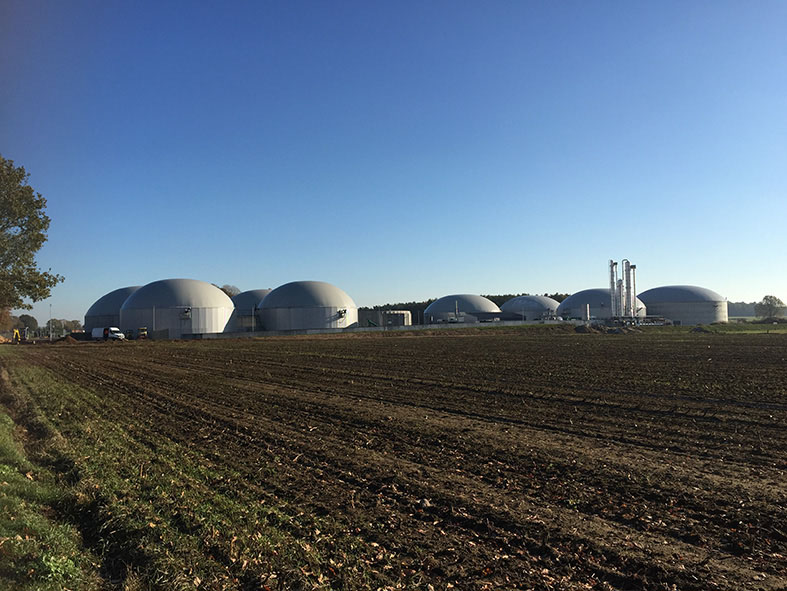
WELTEC digesters In the construction of the three 4,000 cubic meter sized fermenters and the two receiver containers, WELTEC counted on the tried and tested, e.g. the material being stainless steel. The stainless steel cladding considerably contributes to the quick and safe completion of the plant. With this system, WELTEC can guarantee the same high-quality container characteristics world-wide. For the high degree of automation and the precise plant control, the German plant construction company relies on its experience from the construction of the industrial biomethane refineries in Könnern and Arneburg, which were visited by the Finnish investors and operators in advance.

The plant construction company integrated an in-house innovation for the feeding of substrate – the MULTIMix: with this, fibrous input materials such as grass silage, straw or co-substrate are disintegrated. This way, these normally difficult-to-process substrates can be decomposed excellently into biogas by the bacteria. Similarly, there is the option for a foreign body separation upstream of the pump and stirring systems of the plant. In this fashion, the new feeding system reduces the stress on the stirring system as well as the wear of the Finnish plant. Furthermore, the plant operator will, in the future, also be able to flexibly choose input materials and can rely on cheap, but difficult-to-process substrates.

This advantage was decisive since, in the future, additionally fox and mink excrements from a nearby fur farm are going to be processed. In the initial phase, only wastewater, grass and straw will be used as fermentation substrates. Additionally, manure from a total of three pig sties of a business located a few kilometres away will enter the fermenters via pipelines.

A coordinated manure and fertiliser management assures that after the completion of the fermentation process on the one hand sufficient high quality fertiliser for the farmers of the region is available and will contribute to the nutritional supply of the surrounding fields. On the other hand, the statutory nitrogen limits in the region are adhered to so that the ground water is not overburdened with nitrate.

In energy production, the Finns have to increasingly count on their own resources in order to decrease their dependency on the import of energy carriers. There is a need for this since the trade deficit in 2011 increased by 40 percent compared to the previous year. In comparison to its neighbour, Norway, which is almost completely taking care of its supply via water power generation and can export its raw materials, the Finns do not have access to any substantial oil, gas or coal reserves.

Aside of a strong expansion of nuclear power, Finland is therefore most strongly counting on biomass among the renewable energies. The preferred form of utilisation is based quite considerably on the enormous supply of wood in the forest-rich country as well as the sufficiently large deposits of peat and the volume of refuse. This biomass richness ensured that in Finland in 2011 the power generation from wood biomass (22 percent) even exceeded that of nuclear power (17 percent). By comparison: only approx. three percent were generated by water power und only 0.1 percent by wind power. Photovoltaics play next to no role at all in Finland.

Biogas plants are to be expanded, especially in the area of the waste industry. According to the Association for Foreign Trade, a total of more than 30 biogas plants are in concrete planning in Finland. In this, WELTEC BIOPOWER, the plant construction company from Lower Saxony, can particularly shine through its numerous references from 24 countries, among them the existing waste biogas plants in Finland, as well as its special technologies in the area of waste utilisation. This also was the decisive issue for the Finnish customer to decide for a biogas plant by WELTEC BIOPOWER.


Featured News Release Two

SECOND GENERATION AND ADVANCED BIOFUELS INDUSTRY CALLS FOR SOLID BIOFUELS REGULATION

May 2013

Leaders of Sustainable BiofuelsThe Leaders of Sustainable Biofuels (LSB) met the European Parliament (EP) in Brussels on the 8th of May 2013. The meeting was hosted by the ITRE (Industry, Research and Energy) Committee, chaired by Mrs Amalia Sartori.

The vice-President of the European Parliament, Mr Alejo Vidal Quadras, welcomed the Leaders and introduced the positions of the EP ITRE Committee on the European Commission revision of the Renewable Energy Directive - RED.

The positions expressed by Mr Alejo Vidal Quadras, the Rapporteur of the ITRE Committee, and reported in his draft ITRE Draft Opinion, were supported by the Leaders of Sustainable Biofuels.

The Leaders sent a clear message to the Parliament members: "Second Generation Advanced Biofuel technologies are ready to compete with conventional biofuels, with companies keen to invest in commercial projects given appropriate conditions", the Leaders said.

Such conditions include a long-term stable legislative framework and specific targets for the use of Second Generation Advanced Biofuels (1). The European Advanced Biofuel Industry is the most technologically advanced  in the world,  leading the development and commercialization of biofuels in an innovative and competitive field. This is possible thanks to significant  investment from (the members of the LSB), and considerable support from the European Commission and the Member States.

These technologies and the associated sustainable biofuel chains are needed to reduce greenhouse gas emissions, decarbonise transport and improve air quality. Furthermore, large-scale production of Advanced Biofuels would create thousands of permanent direct and indirect jobs.

Now is the time to bring advanced second-generation biofuels to the market”, the chairman of LSB said. “The industry is committed to delivering on its promise but  we need the stable long-term investment conditions which encourage investment while at the same time promoting true advanced biofuels. This will have a positive economic as well as ecological impact on the EU.”

Today the  competition in this sector is on the rise and to promote investment in advanced biofuels in the EU requires immediate action by creating a stable and reliable long term framework.  The risk for the EU is that investments will occur anyway but elsewhere, where more favorable policies and investment conditions exist, as in the US, South America, and Asia.

A minimum two per cent mandate for Advanced Biofuels should be set as a sub-target of the RED, with a well defined and growing pathway to 2025-2030, aligning policies with market realities, securing long term perspectives and mobilising resources into commercial activities. Sustainability should be maintained as the reference criteria to evaluate any biofuel production. Certification schemes should also be further developed, harmonised and adapted to respond to the specific characteristics of lignocellulosic fuel chains, particularly when produced from agricultural and forestry residues and wastes (no land consuming feedstocks).

"These actions are essential if the EU wants to meet the Climate and Energy Policy targets", the Leaders said.

The Leaders of Sustainable Biofuels

The LSB is a group composed by the Chief Executive Officers of seven Leading European biofuel producers and European airlines. The initiative aims at supporting the development of second generation biofuels in Europe. The leaders of Chemtex, British Airways, BTG, Chemrec, Clariant, Dong Energy and UPM are joining forces to ensure the market uptake of advanced sustainable biofuels by all transport sectors.

email: info@sustainablebiofuelsleaders.com
Website: http://www.sustainablebiofuelsleaders.com


Click for: Terms of Usee
Disclaimer: The information presented and opinions expressed herein are those of the authors and do not necessarily represent the views of EnergyTrace.com and/or its partners.

World Energy Consumption

World Consumption of Energy current for 2013
Countries Billions BTUs
China
United States
Russia
Middle East
India
Japan
Canada
World Total
EnergyTrace.com


Author Submissions

Energy Trace is a global leader in online energy news. Our aim is to inform professionals, educators, students, and members of the public. In order to maintain a good, steady supply of up-to-date information we are keen to publish original articles. We are particularly interested in articles from engineering professionals in any of the energy areas Energy Trace covers. For more information click here.